QQQ GEX | Invesco QQQ Trust Real-Time Gamma Exposure & Intraday Levels
Monitor real-time QQQ GEX, 0DTE dollar net gamma exposure, Call Walls, Put Walls, and Zero Gamma Flip thresholds. Quantify how options market maker delta hedging obligations dictate Nasdaq-100 price pinning and volatility.
Invesco QQQ Trust · Net GEX & Volatility Boundaries
Underlying QQQ
Per 1% Move
Primary Overhead Resistance
Primary Downside Support
Regime Transition Threshold
| Metric Level | QQQ Strike | Distance from Spot | Market Maker Role | Volatility Impact |
|---|---|---|---|---|
| QQQ Call Wall | $740.00 | +18.34 pts (+2.54%) | Heavy Call Open Interest Pin / Major Resistance | Dealers Short Calls / Damping Upward Surges |
| QQQ Spot Price | $721.66 | 0.00 pts (Current) | Underlying Invesco QQQ Trust Cash Value | Mean-Reverting Intraday Flow |
| QQQ Zero Gamma Flip | $727.99 | +6.33 pts (+0.88%) | Long to Short Gamma Transition Threshold | Volatility Shift Zone (Long GEX → Short GEX) |
| QQQ Put Wall | $700.00 | -21.66 pts (-3.00%) | Heavy Put Open Interest Floor / Primary Support | Dealers Long Puts / Buying Index Futures on Dips |
| 0DTE Intraday Gamma | PRO EXCLUSIVE | Sub-second live streaming | Real-time 0DTE Call/Put Wall migrations & intraday gamma flip alerts | Unlock in Pro ($99/mo) |
QQQ Pre-Market Institutional Outlook & Plain-English Interpretation
With QQQ spot trading at $721.66 (below the Zero Gamma Flip of $727.99), options market makers operate in a Negative Gamma Regime. Dealers are forced to hedge pro-trend: dumping futures as the market declines and buying aggressively into rallies. This amplifies directional momentum, resulting in sharp trend expansions and wider intraday ranges.
Primary overhead resistance is anchored at the QQQ Call Wall ($740.00), representing a distance of +18.34 pts (+2.54%). Primary institutional downside support rests at the QQQ Put Wall ($700.00), located -21.66 pts (-3.00%) below current price.
Mean-reversion fades at Put Wall touches offer favorable 3:1+ risk-to-reward setups, while rallies into the Call Wall face persistent dealer selling pressure.
Understanding Real-Time QQQ Gamma Exposure (QQQ GEX)
What is QQQ Gamma Exposure (QQQ GEX)?
QQQ Gamma Exposure (QQQ GEX) measures how Invesco QQQ Trust market maker option positions force real-time delta hedging. Positive QQQ GEX suppresses market volatility by compelling dealers to buy dips and sell rallies, while negative GEX accelerates Nasdaq selling pressure.
In financial options markets, QQQ gamma exposure represents the mathematical rate of change in options market maker deltas relative to underlying price shifts in the QQQ share value. Because options dealers maintain delta-neutral books, any movement in the Nasdaq-100 forces market makers to dynamically buy or sell QQQ shares or futures to remain hedged.
When institutional traders purchase call options, market makers take the opposing side by shorting calls and buying underlying shares to hedge delta. As QQQ rises, the call delta increases, forcing dealers to buy additional shares to remain neutral. This programmatic feedback loop is at the heart of modern market microstructure and makes the GEX Horizon Real-Time Gamma Dashboard an indispensable tool for active equity traders.
Live QQQ Net GEX Current Value & 0DTE Breakdown
Explore real-time net dollar gamma levels across all expirations, zero-day contracts, and monthly settlement cycles using our interactive Gamma Heatmaps and Gamma Histograms.
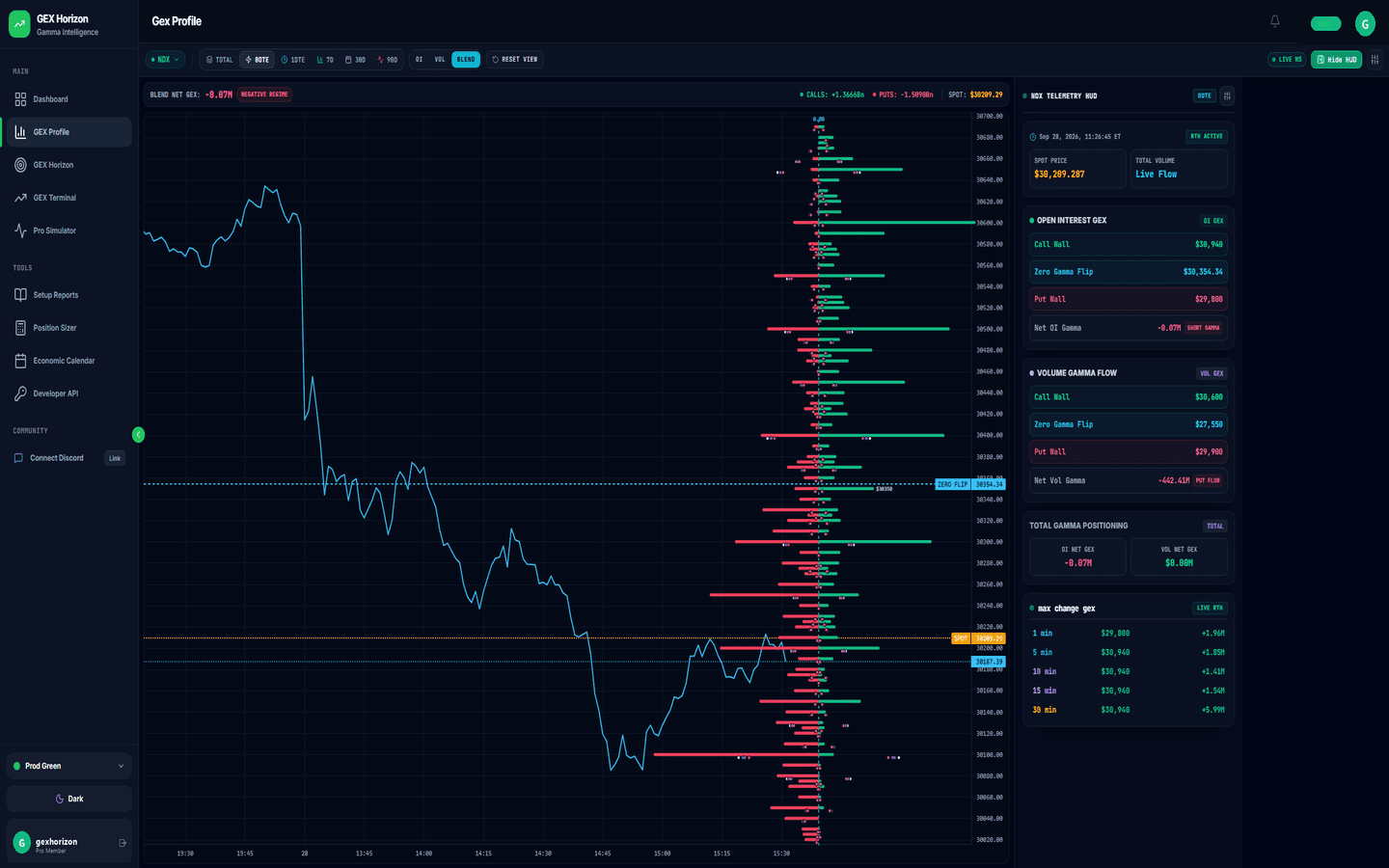
0DTE QQQ Net GEX Current Value vs All Expirations
Zero Days to Expiration (0DTE) QQQ options account for over 40% of daily CBOE options volume. Because 0DTE options possess extremely high gamma decay, rapid retail and institutional order flow shifts can rapidly flip the QQQ net GEX current value within minutes during market hours.
American-Style Physical Delivery vs European-Style Cash Settlement (NDX)
Chicago Board Options Exchange (CBOE) NDX options are European-style, cash-settled contracts based directly on the Nasdaq-100 index without early exercise risk. In contrast, QQQ options are American-style ETF derivative contracts with physical share delivery. While NDX dealers hedge directly via Nasdaq futures, QQQ market makers hedge via share baskets and ETF creation units.
QQQ Call Wall, Put Wall & Zero Gamma Flip Matrix
Options market makers dictate the boundaries of daily volatility. The three primary structural anchors are the Call Wall, the Put Wall, and the Zero Gamma Flip.
By multiplying strike-level gamma by total open interest (verified daily via the Options Clearing Corporation (OCC)) and scaling by index spot value, GEX Horizon calculates the dollar gamma market makers must rebalance for every 1% move in the ETF.
How Dealers Rebalance Delta at the QQQ Call Wall and Put Wall
The QQQ Call Wall serves as formidable intraday resistance. When dealers are short calls, they must buy QQQ shares as the price approaches the wall strike to cover delta. However, once the wall is reached, call selling exhaustion usually halts momentum. The QQQ Put Wall represents the strike price with the largest negative gamma concentration, serving as critical support where market maker hedging cushions downside sell-offs.
Identifying Volatility Suppression vs Volatility Expansion Regimes in QQQ
Trading above the QQQ Zero Gamma Flip level places the market in a positive gamma regime. Market makers hedge by buying dips and selling rallies, suppressing volatility. Conversely, falling below the flip level triggers a negative gamma regime. Market makers are forced to sell into declines and buy into rallies, accelerating volatility and widening intraday trading ranges.
Institutional QQQ Intraday Trading Playbook: Executing GEX Setups
Professional derivatives desks leverage strike-level dealer hedging obligations to identify intraday momentum surges, pinpoint exhaustion boundaries, and execute tactical Nasdaq-100 ETF exposures. Here are three primary execution setups tailored to QQQ market microstructure.
Call Wall & Put Wall Boundary Fades
When QQQ trades above its Zero Gamma Flip line, dealers operate in positive gamma. Approaching the Call Wall, market makers must aggressively sell QQQ shares and E-mini NQ futures to neutralize expanding long deltas, damping further upside momentum.
Zero Gamma Flip Regime Transition
Breaching the QQQ Zero Gamma Flip alters market maker behavior instantly. Below the flip, dealers must sell into declines and buy into rallies to remain delta neutral, accelerating downward market velocity.
0DTE Afternoon Strike Pinning
During the final two hours of the trading session, 0DTE option contracts undergo severe time decay. Options desks managing heavy near-the-money volume continuously re-hedge, creating a powerful magnetic pull toward peak open interest strikes.
Higher-Order Derivatives Dynamics: How Vanna and Charm Alter Dealer Hedging in QQQ
Standard gamma exposure measures dealer hedging adjustments driven solely by underlying ETF share price movement. However, active market makers continuously rebalance deltas in response to changes in implied volatility (Vanna) and the passage of time (Charm).
The Implied Volatility Feedback Loop
Vanna measures the rate of change in option delta relative to shifts in implied volatility. Because institutional tech investors systematically hold out-of-the-money puts for portfolio protection, options market makers are predominantly short put volatility.
When implied volatility compresses during an orderly tech sector advance, the delta of those dealer puts diminishes. To maintain delta neutrality, market makers are compelled to purchase QQQ shares and E-mini NQ futures. This mechanical dynamic creates a persistent structural bid, often driving continuous melt-up market regimes across large-cap tech.
The Intraday Time Decay Unwind
Charm measures the rate of change in option delta with the passage of time. With daily 0DTE options expirations dominating QQQ volumes, time decay accelerates sharply throughout the trading day.
As expiration approaches, the deltas of out-of-the-money options erode toward zero. Market makers holding short hedges against these contracts must systematically unwind their positions. On sessions with elevated out-of-the-money put open interest, Charm decay generates predictable afternoon buying pressure into session settlement.
Market Maker Delta Hedging Mechanics in QQQ Options
Options market maker delta hedging is the core transmission mechanism linking derivative flow to cash market price actions.
Institutional traders utilize this mathematical metric to anticipate liquidity buffers and market maker order flow toxicity. For an in-depth mathematical walkthrough, consult our full guide on How to Calculate and Interpret Gamma Exposure.
Frequently Asked Questions: QQQ GEX & Intraday Levels
Essential answers regarding Invesco QQQ Trust options gamma exposure, market maker delta hedging, and intraday level interpretation.