1-Step vs 2-Step Prop Firm Evaluations: Which Model is Easier to Pass with GEX?
Retail evaluation fail rates exceed 94% across both 1-step and 2-step models, but for completely different mathematical reasons. Discover how profit-to-drawdown difficulty ratios differ between models, explore how dealers hedge across 10 consecutive sessions of Gamma Flips, and learn how to deploy Options Gamma Exposure (GEX) levels tailored to your exact challenge rules.
1. The Evaluation Architecture Dilemma
When entering the proprietary trading space, traders are immediately confronted with two competing structural formats:
Apparent Speed vs Hidden Drawdown Friction
Traders are attracted to 1-step challenges because there is only one profit target (typically \$3,000 on a \$50K account, or 6%). However, the hidden penalty is the intraday trailing drawdown. The threshold ratchets up tick-by-tick with unrealized open profit, permanently destroying your margin for error if open profits retrace.
Cumulative Profit Hurdle vs Static Cushion
Traders must pass Phase 1 (typically 10%) and then Phase 2 (5%), requiring a cumulative 15% return (\$7,500 on a \$50K account). However, the major advantage is a static or end-of-day drawdown buffer that does not move intraday, allowing winning positions to breathe through normal intraday pullbacks.
2. Evaluation Architecture: 1-Step vs 2-Step Comparison Matrix
| Feature | 1-Step Model (Futures) | 2-Step Model (CFD / FX) | GEX Level Edge |
|---|---|---|---|
| Profit Target | 6% - 8% (Single phase) | 10% Phase 1 + 5% Phase 2 (15% total) | Fades at major walls hit targets in 3-5 days |
| Drawdown Model | Intraday peak trailing (High-Water Mark) | Static baseline or EOD settlement | Tight 4-6 pt stops prevent trailing erosion |
| Daily Loss Cap | Strict $1,000 - $2,500 hard daily limit | 5% of starting equity per day | Zero Gamma Flip filter halts trading on bad days |
| Overnight Holding | Prohibited (Flatten by 4:59 PM ET) | Permitted on Swing accounts | Exploit multi-day Call/Put Wall migrations |
| Time Restrictions | No time limit (Pass at your own pace) | No time limit (Modern standard) | Wait patiently for Tier-1 Wall interactions |
| Difficulty Ratio | 1.50x (Target ÷ Buffer) | 1.50x to 1.80x (Target ÷ Buffer) | 3:1+ R:R setups drop ruin probability <3% |
1-Step vs 2-Step Prop Firm Feasibility & Risk Calculator
Compare effective profit-to-drawdown difficulty, trailing watermark penalties, and optimal GEX trade setups.
Single Phase (6%)
Intraday peak trailing watermark
Target ÷ Drawdown buffer
At 45% win rate with 3:1 R:R
In the 1-Step Model, your primary hazard is intraday peak ratcheting. Do NOT trade momentum runners below Zero Gamma Flip where drawdowns expand. Focus exclusively on Long Gamma mean-reversion fades at Call/Put Walls and take partial profits at the first opposing strike to lock in realized gains.
3. Market Structure Mechanics: 10 Consecutive Sessions of Gamma Flips
To understand why trading strategy must adapt to your evaluation model, examine how options market makers hedge as the underlying index interacts with the Zero Gamma Flip over a multi-session sequence.
A. Sessions 1–4: The Long Gamma Mean-Reversion Pin (Optimal for 1-Step)
Spot > Zero FlipDuring sessions where spot price trades safely above the Zero Gamma Flip level, options dealers hold net positive gamma. When price rallies toward the Call Wall, market makers sell underlying futures; when price dips toward the Put Wall, market makers buy futures. This mechanical counter-trend flow dampens volatility, compressing daily trading ranges.
B. Sessions 5–7: The Zero Flip Breakdown & Short Gamma Expansion
Spot < Zero FlipWhen price breaks below the Zero Gamma Flip, market maker hedging flips from mean-reverting to trend-accelerating. Dealers are forced to sell futures as the market declines and buy as it rallies. Realized volatility triples, leading to 60-to-100 point trend sessions.
C. Sessions 8–10: Wall Absorption & Strike Migration
Put Wall DefenseAt terminal Put Walls, heavy institutional put open interest creates an immense delta absorption barrier. As long as the wall holds on daily closes, the market establishes a swing bottom. Once spot crosses back above the Zero Gamma Flip, the regime resets back to Long Gamma.
4. Verified Community Results & Prop Firm Proofs
Real traders in the GEX Horizon community actively pass both 1-step and 2-step evaluations using our real-time options dealer levels. Review authentic, unedited platform screenshots and trader reviews from our Discord community:
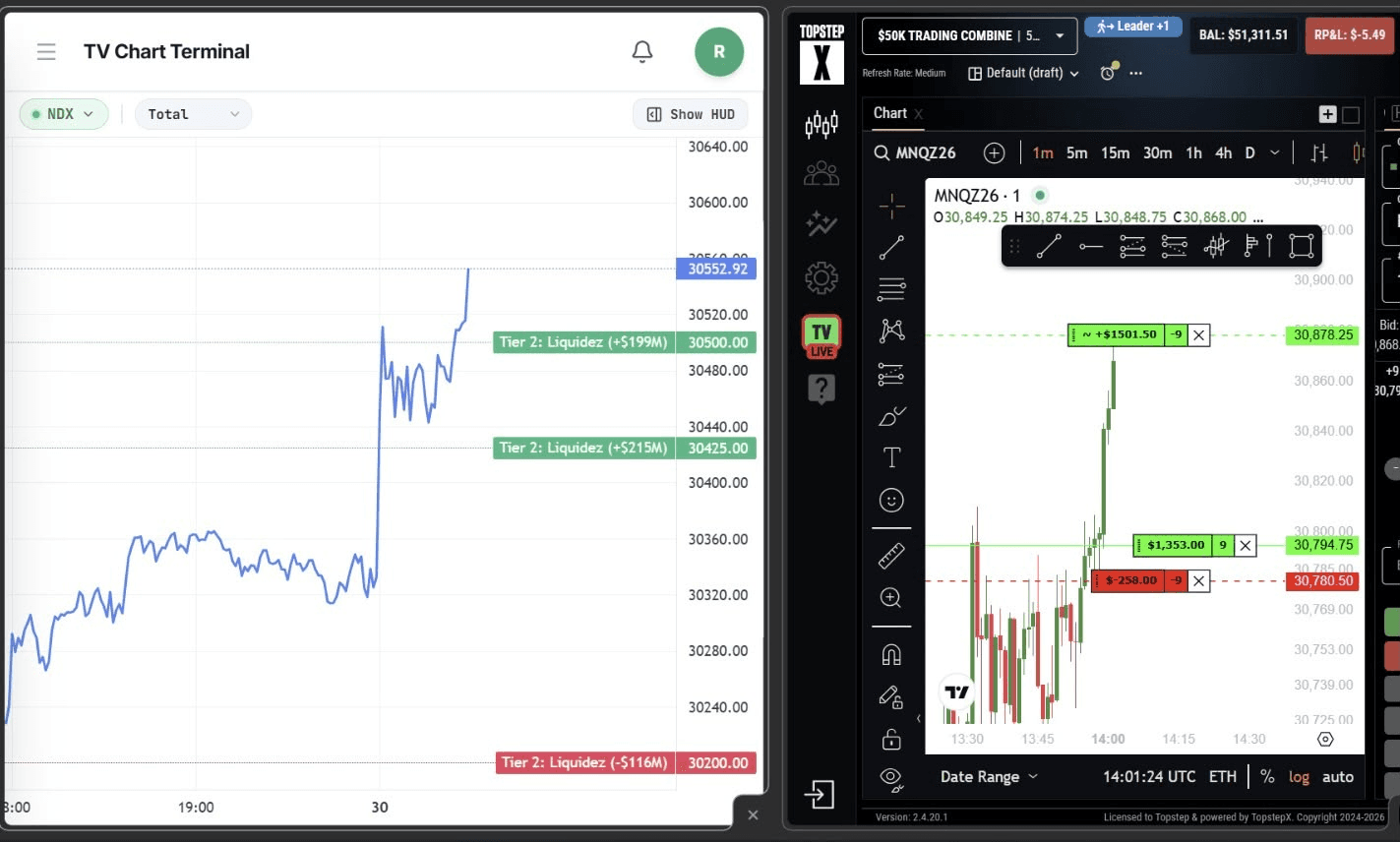
Clean execution holding the institutional liquidity sweep on MNQ. Level precision prevented trailing drawdown breach.
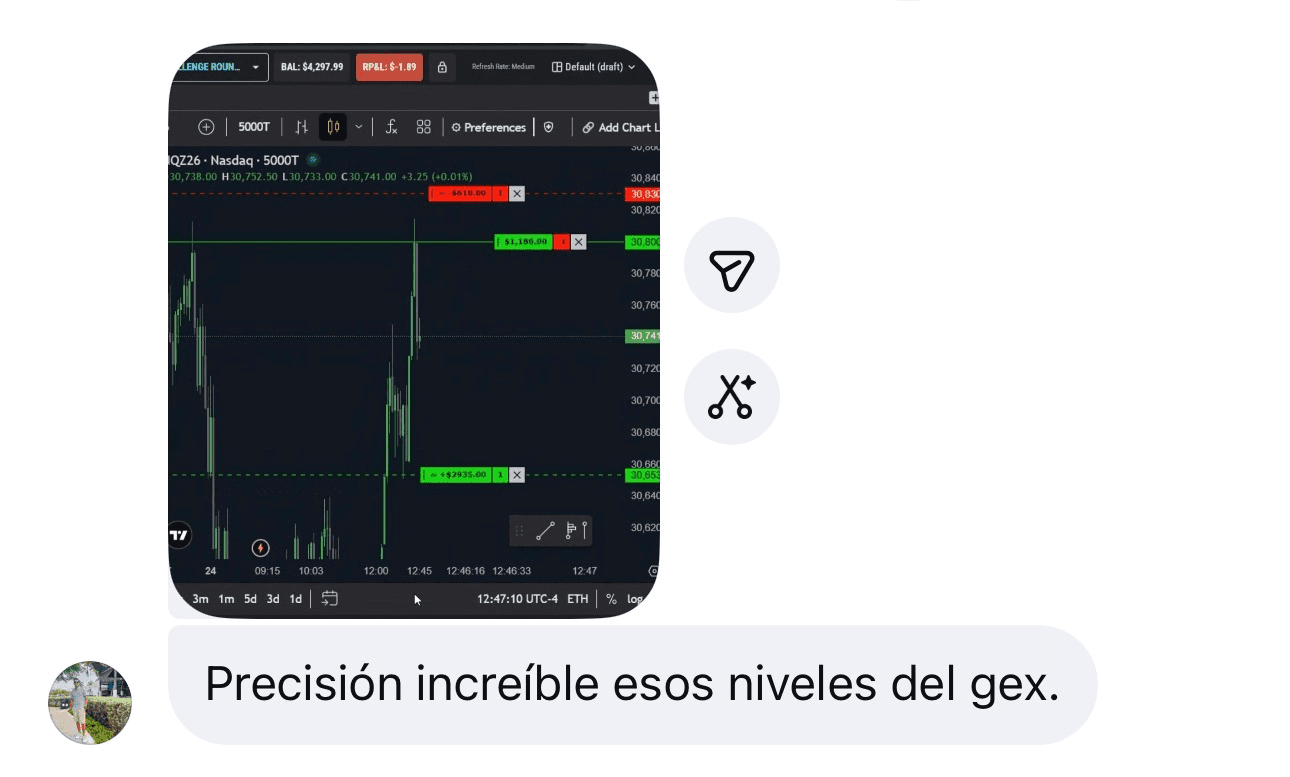
"The levels on NQ are ridiculous. Knowing where the Call Wall and Put Wall are kept me from revenge trading during CPI."
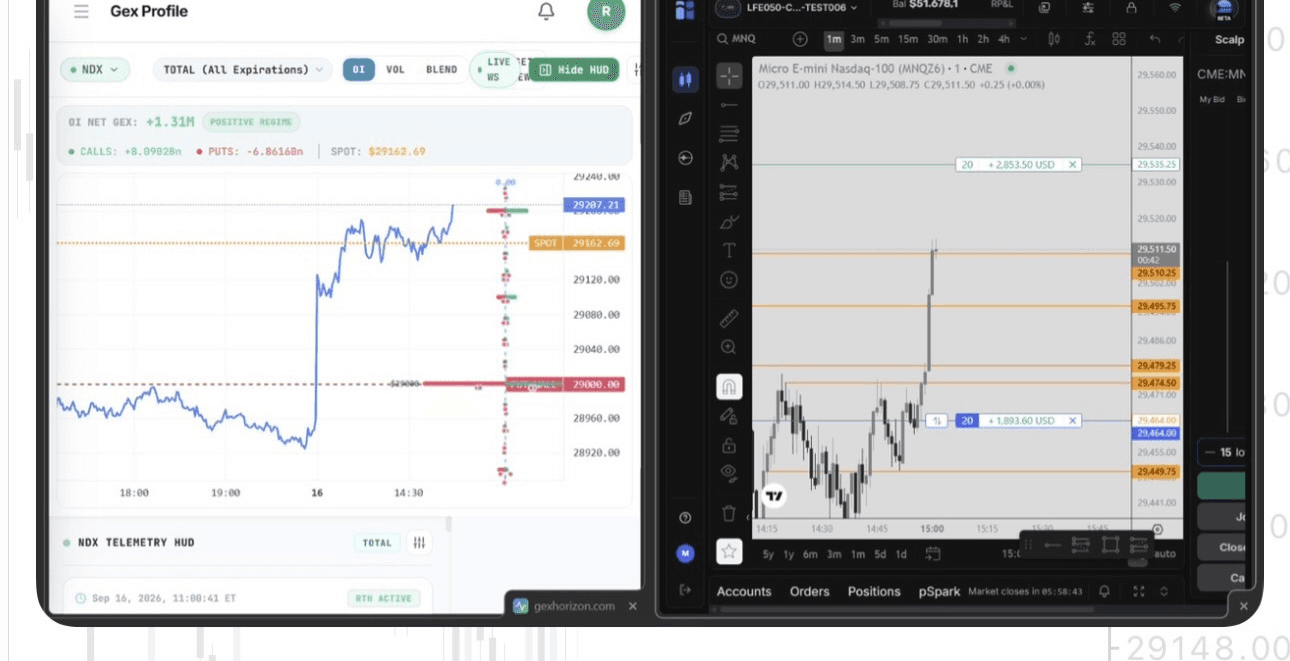
Entry long anchored precisely at the Put Wall floor on Nasdaq futures, capturing the institutional delta absorption bounce.
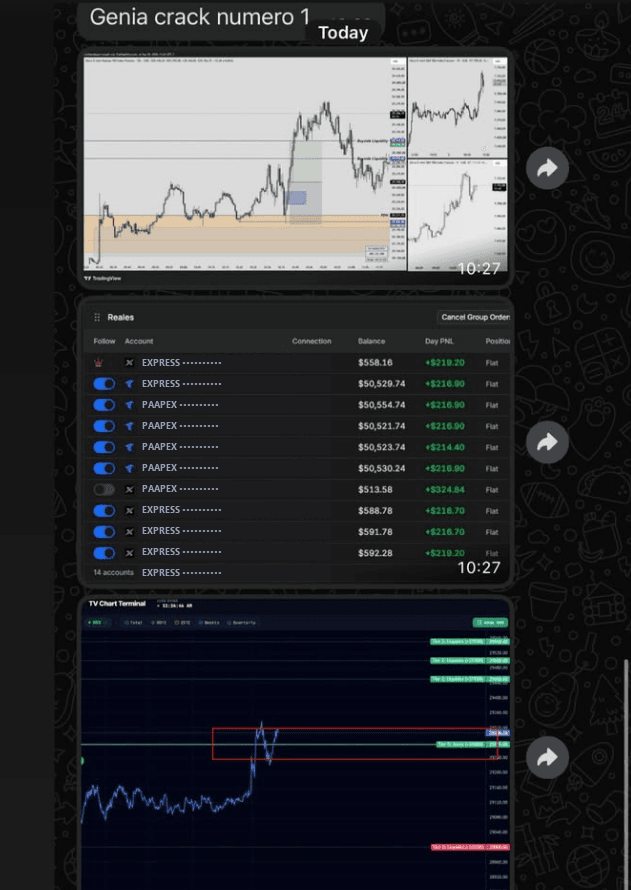
Replicating GEX level fades across 14 synchronized prop firm accounts simultaneously using automated trade copiers.
5. Model-Specific Execution Rulebooks
Rulebook for 1-Step Traders (Apex / Topstep)
Intraday Trailing- Take partial profits at first target: Scale 50% to 75% when price reaches the Zero Gamma Flip. Do not allow large open profits to retrace and drag your trailing liquidation watermark upward.
- Only trade Put/Call Wall fades: Avoid middle-of-the-range breakout entries where choppiness erodes trailing room.
- Cap risk per trade at $150–$200: Use micro contracts (MES) rather than minis (ES) to guarantee at least 10–12 consecutive loss buffers.
Rulebook for 2-Step Traders (FTMO / FundedNext)
Static / EOD- Run Wall-to-Wall runners: Because static drawdown doesn't ratchet, you can hold runner positions from Put Wall all the way to Call Wall for 4:1+ asymmetric windfalls.
- Exploit multi-day regime transitions: Swing accounts allow holding over settlement, capturing the complete expansion move as dealers re-hedge options volume.
- Strictly enforce the 5% daily loss cap: Discontinue trading for the session if cumulative losses hit 2.5% to protect the phase.
Complete Prop Firm Evaluation Strategy Cluster
Frequently Asked Questions: 1-Step vs 2-Step Evaluations
What is the main difference between 1-step and 2-step prop firm evaluations?
A 1-step evaluation (common in futures firms like Topstep and Apex) requires reaching a single profit target (usually 6% to 8%) to qualify for funding, but typically enforces an aggressive intraday trailing drawdown. A 2-step evaluation (common in firms like FTMO and FundedNext) requires passing two consecutive phases (usually 10% Phase 1 and 5% Phase 2, totaling 15%), but offers a more forgiving static or end-of-day (EOD) drawdown buffer.
Which prop firm evaluation model has a higher historical pass rate?
Statistically, 2-step models with static drawdown have a higher long-term pass rate for disciplined traders because static drawdowns do not penalize unrealized open equity. In contrast, 1-step models with intraday trailing drawdowns suffer higher failure rates because pullbacks in open profits permanently reduce the trader's remaining margin for error.
How does Options Gamma Exposure (GEX) help pass 1-step evaluations?
In 1-step evaluations, GEX levels protect traders from trailing drawdown ratcheting. By trading exclusively when spot price tests Major Call Walls or Put Walls during Long Gamma regimes, traders enter at high-probability dealer absorption turning points with tight 4-to-6 point invalidation stops, preventing wide retracements that destroy trailing buffers.
Can you hold positions overnight in 1-step and 2-step evaluations?
Most 1-step futures combines require all positions to be flattened prior to the CME daily close (around 4:59 PM ET). In 2-step models (particularly Swing account tiers), traders are permitted to hold positions overnight and over weekends, allowing for multi-day mean-reversion plays between major options open interest walls.
Should I trade ES or MES in a $50,000 prop firm evaluation?
Micro E-mini contracts (MES) are strongly recommended over standard mini contracts (ES). On a $50,000 evaluation with a $2,000 trailing drawdown buffer, trading 1 ES contract risks $50 per point—a 10-point move represents $500, or 25% of your entire account lifeline. Micro contracts ($5 per point) allow you to risk $150 to $200 per trade, giving you the statistical breathing room to survive standard market variance.
Trade with Real-Time Institutional Options Gamma Levels
Whether you trade 1-step futures combines or 2-step static accounts, trade with dealer positioning on your side. Get real-time Call Walls, Put Walls, and Gamma Flip levels on SPX, QQQ, and NVDA.